Lunch time at UMC is a little bit like that one scene from Fantasia in which the creatures of the night take over after the world goes to sleep, except there aren't any devils or dead things involved in this overtaking.
I'm not very fond of those things anyway.
As usual, my office is dark with only three light sources: my laptop, the computer provided by UMC, and the light that hangs below my bookshelf (I learned early on that I write better in the dark).
The only audible sounds in my office are the rapid twitter of the keys on my laptop and the electr0-industrial trance station I chose from Pandora.com (online radio station).
I just finished transcribing a 45 minute interview with one of the Child Life interns at Johns Hopkins and I'm feeling inspired by her desire to give back to the community/ do good.
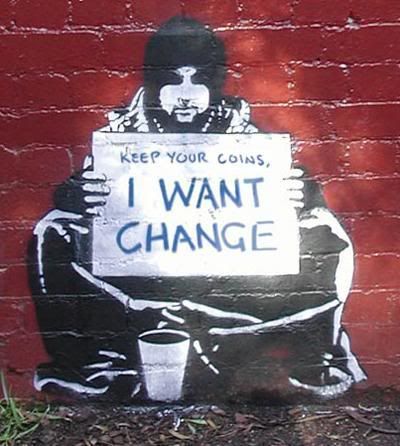
I am also inspired to do good for the community and make the world a better place, so I'm going to make today's theme something that I've always believed in, but hope to apply to my time here and to my career: be the change you want the world to be.
I first saw this on a necklace in a clothing catalog when I was visiting my best friend during Winter Break. I identified with it because I understood that its message was to encourage people to become active members of the world community/ encourage them to do instead of think about doing. When I was a freshman in in high school, I became involved in activities that gave back to different communities and provided some sort of positive change to our state of being. Since then, I have come to believe that the only way for there to be change in the world is for its citizens to get up and make a difference in some large or small aspect.
What does community service have to to with journalism and editing? Quite a bit, actually. Journalists and editors influence/ reflect the thoughts, motives, desires, and actions of an institution or society; therefore, it is my job to engage others through valuable content. But so much of the industry is focused on getting better abs or talking about scandalous photographs of Michael Phelps; very few are focused on the things that really matter. What sort of rhetorical argument(s) are we making with articles like the Phelps articles? What does this mean to the world community?
Who profits intrinsically from making scandals? I don't think anyone does. I don't think a story is a good story unless it talks about a relevant, pressing issue (celebrity scandals don't fit into that category); gives you an itch to learn more; or makes you say, "whoa" at the end.
And like most Americans, my abs are in much need of improvement, so I don't think I would make a credible author for a fitness magazine. In the meantime, I 'm going to find other stories that are timely and worth the read.
It's what I do (literally).


No comments:
Post a Comment